TL;DR
This meeting centered on honoring local law enforcement for extraordinary bravery during an active shooter incident, alongside advancing public art and downtown enhancement initiatives. The City Council efficiently approved the police Valor Awards, the America 250 art installation, and a suite of routine consent agenda items. The most significant outcome emerged from an extensive committee debate on video gaming regulations, where officials directed staff to draft two separate ordinances establishing strict license caps and a 100-foot property-line setback with continuous-use grandfathering to balance municipal control with local business equity.
Proclamation for Police Department Valor Award
The City Council sought to formally recognize the heroic actions of four local police officers who risked their lives during an active shooter standoff, highlighting the extreme personal danger faced by law enforcement to protect innocent children and citizens.
- Honored Officers: The Batavia Police Department awarded its highest honor, the Valor Award, to Sergeant Michelle Langston, Sergeant Brian Lorden, Officer David Saad, and Officer Alexander Buehler.
- Incident Details: On August 16, 2025, officers responded to a welfare check at 1211 East Wilson Street involving a suicidal subject cutting himself in the presence of children. The scene rapidly escalated as screaming was heard inside and forced entry attempts failed.
- Officer Actions:
- Sergeant Michelle Langston retrieved breaching tools, coaxed a child who leaped covered in blood from a second-story balcony to safety, obtained critical intelligence that the suspect was armed with an AR-15, and exposed herself to gunfire a second time to rescue a second child (who was momentarily pulled back inside by the suspect).
- Sergeant Brian Lorden held the interior hallway alone in a tactical position, astutely recognized the distinct sound of an AR-15 being loaded and charged, warned responding personnel, and coordinated regional SWAT resources.
- Officer Alexander Buehler established a perimeter, relayed critical field intelligence, and directed nearby residents to shelter in place.
- Officer David Saad deployed non-lethal chemical pepper balls into the apartment balcony to disorient the suspect, enabling the second child to jump. He shielded both children behind a squad car and returned fire when the suspect opened fire on officers and bystanders.
- Outcome: Over seven minutes, the suspect fired upwards of 70 rounds before taking his own life. The officers’ tactical discipline prevented any civilian or law enforcement casualties. The City Council unanimously approved the proclamation.
Consent Agenda
The council reviewed the consent agenda to efficiently approve routine municipal operations, financial disbursements, and minor policy resolutions without requiring individual floor debate.
- Financial Approvals: Approved payroll fund totals for July 17, 2026, amounting to $1,203,293.36, and accounts payable totaling $3,801,246.40.
- Strategic & Operational Resolutions: Authorized a contract with RKG Associates for the 2026 Economic Development Strategic Plan (Resolution 2026-75-R), Microsoft Enterprise Services payments (Resolution 2026-79-R), and electric undergrounding easements for Woodland Hills (Resolution 2026-78-R).
- Capital Improvements & Land Use: Approved Change Order No. 7 with IHC for Phase 2a of the Wastewater Treatment Plant (Resolution 2026-77-R), property annexations on Deer Path Road (Ordinance 2026-28), and a demolition Certificate of Appropriateness for 330–338 Webster Street (Ordinance 2026-30).
- Grant Creation: Formally created the Downtown Batavia Enhancement Grant Program (Resolution 2026-43-R), which an Alderperson publicly praised as an essential tool for local business owners to upgrade storefronts and facades.
- Vote: Passed with 11 affirmative votes, two absences, and one recusal.
Batavia Main Street Update
The Main Street Executive Director updated the council on downtown design grants, small business incubation programs, and promotional metrics aimed at increasing downtown foot traffic.
- Downtown Design Grants: Received 12 applications requesting $53,000 in funding; the city’s $10,000 budget allocation was distributed across six local businesses for exterior beautification.
- Main Street America Review: Representatives from Main Street America conducted a biannual audit, touring vacant commercial sites (including North Island, Batavia Plaza, and North River Street) to refine “retail readiness” and establish a structured pipeline from boardwalk incubator shop to permanent brick-and-mortar locations.
- Marketing Impact: A state-funded promotional e-blast sent to 10,000 recipients achieved a 43% open rate and a 71% click-through rate, which participating local merchants reported directly translated into strong weekend sales spikes.
Sale of Surplus Property (Shabonna Trail Lot)
City staff managed a public bid opening for an unneeded parcel of surplus municipal land east of 706 Shabonna Trail to return the property to taxpaying private ownership.
- Bidding Process: Utilizing a three-notification statutory process, the city was legally permitted to accept bids below the parcel’s appraised value.
- Results: A single bid of $10 (meeting the advertised minimum threshold) was submitted by adjacent property owners.
- Terms: The city will retain permanent property easements for municipal utility maintenance and drainage management prior to final council ratification.
America 250 Art Installation Design
The council evaluated final designs for a historic mural series on the police station windows, funded by an Illinois Arts Council Creative Accelerator Fund grant to mark the U.S. Semiquincentennial.
- Artist & Collaboration: Designed by a local high school graduate and prominent area muralist in close collaboration with the Batavia Historical Depot Museum to guarantee strict local accuracy.
- Design Elements: Overlooking the Flag Day Monument, the panels connect the Declaration of Independence’s themes to local history, featuring local historical milestones alongside future-focused imagery (including Fermilab and a family under the Milky Way sky).
- Timeline & Vote: Unanimously approved, with installation scheduled for late summer and a public ribbon-cutting set for mid-September 2026.
City Administrator and Mayor’s Reports
City management provided operational updates regarding task forces, community engagement metrics, and administrative achievements.
- Integrated Resource Plan (IRP) Task Force: Convened its inaugural meeting, elected co-chairs, and adopted a structured discussion framework for reviewing city utility planning.
- Social Media Reach: Educational “Roll Smart” video reels detailing new e-mobility rules—produced in partnership with the Batavia High School incubator class—achieved a record-breaking 156,000 views.
- Department Updates: The Fire Department inducted eight paid-on-call recruits; Human Resources sponsored employee participation in the Callahan Community Center bridge mural; and the Police Department appointed a new detective to its investigations division following internal interviews.
- Community Feedback: The Mayor noted regional praise for downtown riverfront revitalization, adding that Kane County selected the Batavia Council Chambers for an upcoming countywide meeting due to its central location and AV technology.
Proposed Video Gaming Ordinance Amendments (Committee Session)
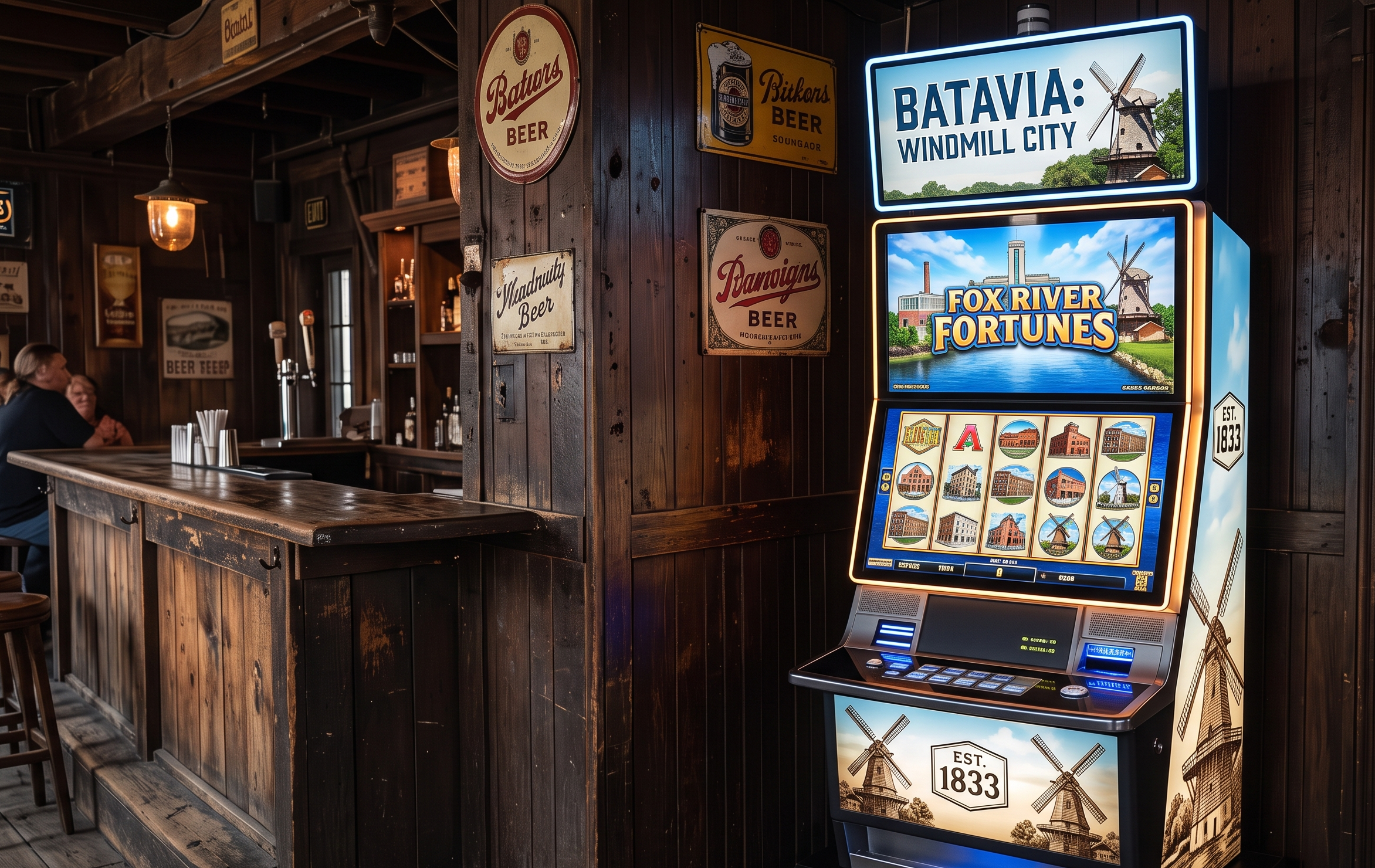
The Committee of the Whole conducted a thorough debate regarding video gaming regulations, attempting to resolve tension between curbing gaming proliferation, establishing objective land-use setbacks, and protecting local business equity.
- License Caps (14 Citywide / 9 Downtown):
- Context: The city currently has 13 active licenses (8 downtown), with 1 pending application from Geneva Winery.
- Pro-Cap Arguments: Capping licenses transfers discretionary control back to the council, removing the legal “presumption of approval” inherent in conditional use permits. Advocates cited neighboring municipal limits (e.g., Downers Grove capping at 20, Aurora and Elgin with total number of machines limits, Naperville/Geneva banning) and argued caps preserve scarce commercial square footage for traditional retail and dining. Additionally, an Alderperson argued that because the city is now located near a major new casino, a cap is a necessary protection to prevent the “overflow gambling” that historically creeps into suburbs surrounding large casinos.
- Anti-Cap Arguments: Opponents argued caps constitute micro-management and artificial economic intervention. Business operators noted gaming revenues directly subsidize employee health insurance, retirement plans, affordable menu prices (preventing “$25–$30 burgers”), and local charitable donations (e.g., $20,000 raised for St. Jude’s).
- Straw Poll: Supported by a 7–5 majority.
- Distance Setbacks & Measurement Rules:
- 100-Foot Buffer: The committee agreed to establish a 100-foot local buffer from public/private elementary, middle, and high schools, as well as religious institutions.
- Property Line vs. Interior Point: To fix ambiguities exposed in past state-level reviews (where state regulators measured 100 feet from an altar to a bar tap, overriding a 75-foot actual building gap), the local code will strictly mandate measurements from property line to property line.
- Exclusions: Parks and public libraries were explicitly excluded from the buffer. Staff mapped out that including libraries would disqualify existing compliant businesses (e.g., East China Inn, Riverside Overflow), while Park District holdings along the Fox River would inadvertently ban gaming across nearly the entire downtown core.
- Grandfathering & Business Equity:
- Debate: A proposal to allow only “one future sale” of a non-conforming gaming establishment was strongly opposed by small business testimony. Business owners explained that terminating gaming rights upon a second transfer drastically reduces property values (e.g., reducing a $500,000 business valuation down to $350,000), effectively stripping owners of their primary retirement nest egg.
- Resolution: The committee reached consensus on continuous-use grandfathering (modeled after non-conforming zoning standards). Non-conforming locations retain gaming rights indefinitely across ownership transfers, provided the gaming operation does not lapse or cease for more than 12 consecutive months.
- Enforcement & Disciplinary Criteria:
- Proposal: Evaluated a “three strikes in three years” automatic license revocation rule modeled after West Dundee.
- Resolution: Police and administrative staff confirmed that Illinois statute and local liquor code already grant the Mayor (acting as Liquor Commissioner) full unilateral power to suspend, fine, or revoke licenses for any single severe offense. The committee chose to drop the rigid “three strikes” text, maintaining the Liquor Commissioner’s flexible disciplinary discretion.
- Direction to Staff: Because combining controversial topics might cause the entire policy package to fail, staff was instructed to draft two separate ordinances:
- Ordinance 1: Establishing a cap of 14 citywide and 9 downtown licenses, alongside clean-up amendments removing video gaming from the zoning code’s conditional use list.
- Ordinance 2: Codifying the 100-foot property-line setback from schools and churches, paired with continuous-use grandfathering protection.
Committee Assignments
The council handled an administrative vacancy to maintain proper governance over municipal operations.
- Appointment: Following the departure of a former council member, an Alderperson was formally appointed based on council seniority to serve as Vice-Chair of the City Services Committee.
- Jurisdiction: The role assists in overseeing public safety (police and fire operations), public works infrastructure, and city-owned property management.
Documents: https://bataviail.community.highbond.com/Portal/MeetingInformation.aspx?Id=209
https://bataviail.community.highbond.com/Portal/MeetingInformation.aspx?Org=Cal&Id=361
Author: Jim Fahrenbach


Leave a Reply