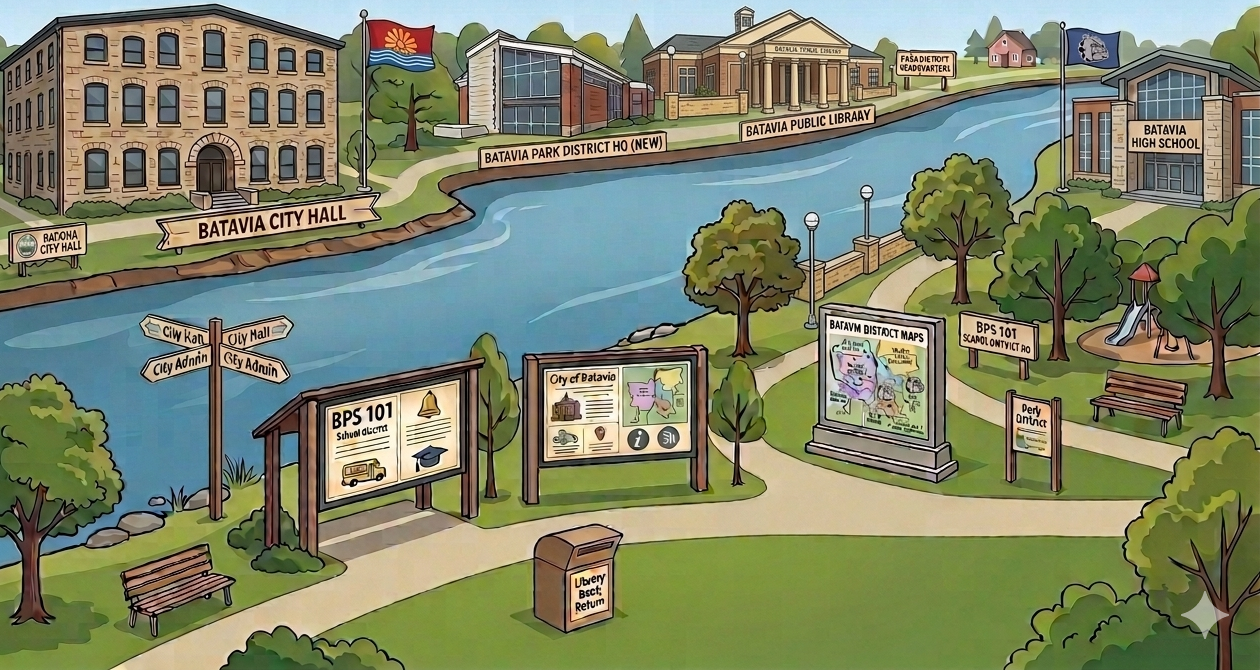
Believe it or not, elections for local offices are fast approaching and will be held April 6, 2027 with candidate petitions going out at the end of this August. All too often, well-meaning people step up to run for these positions without awareness of the day-to-day duties, the actual time commitment required behind the scenes, or even the legal requirements to get on the ballot. Below is an overview of the “basics” of these positions.
If you watch the national news or scroll through social media, you might think all levels of government operate as a continuous battleground over the cultural “hot topics” of the day.
In Illinois, local elections for city councils, school boards, park districts, and library boards are completely non-partisan.
You won’t see an “R” or a “D” next to a candidate’s name on the local Batavia ballot. Partisan elections—along with the party platforms and political polarization that often accompany them—don’t actually begin until you reach the county level (such as the Kane County Board) and go up from there.
That doesn’t mean we haven’t had local “R” and “D” organizations try to endorse local candidates, recently we have, but that process has been long after a candidate is on the ballot and at an extreme distance. Often including not even talking to all the candidates.
Because our local offices are non-partisan, the reality of local governance is much different than what you see on cable news, it’s unglamorous, highly operational, and deeply tactical.
Week after week, our local boards spend roughly 95% of their time on the nuts and bolts of running a community: approving and modifying budgets, reviewing zoning variances for local businesses, responding to residents or parents, and figuring out how to fund sewer linings or replace school roofs. Even a board member’s “passion topic” may only hit an actual meeting agenda once or twice a year, if ever.
Batavia is governed by several distinct taxing bodies, each with its own elected board, specific duties, and meeting schedule. Whether you are considering a run for office, want to make a public comment, or simply want to stay informed on how your tax dollars are actually being spent, it is vital to know how these bodies operate.
Below is a fact-based breakdown of the Batavia City Council, BPS101 Board of Education, Batavia Park District Board, and the Batavia Public Library Board—complete with a side-by-side comparison.
NOTE: While the regular schedules are listed below, there is always the need for additional special meetings, committee meetings, or workshops to be scheduled as required for all of these groups. Also, the internet and social media exposure is significant for these positions.
Batavia City Council
The City Council is the primary legislative and policy-making body for the City of Batavia. It consists of the Mayor and 14 Alderpersons (two representing each of the city’s seven wards).
- Tactical Focus: Adopting the city budget, passing local ordinances, making zoning and land-use decisions (like the adaptive reuse of industrial buildings), overseeing public works (water, sewer, streets), and managing public safety (Police and Fire departments).
- Candidate Requirements: Must be a U.S. citizen, a registered voter, at least eighteen years old, and have lived within the specific ward they seek to represent for at least one year immediately preceding the election.
- Meeting Schedule: Because of the sheer volume of municipal business, the City Council effectively meets weekly. Regular City Council meetings are held on the 1st and 3rd Mondays of the month at 7:00 PM. Committee of the Whole (COW) meetings—where the bulk of the debate and research happens—take place on Tuesdays at 7:00 PM.
- Average Duration: 2.5 to 3.5 hours per meeting (COW meetings can run much longer depending on the current issues and topics).
- Estimated Outside Work: 5 to 10 hours per week (reading thick agenda packets, responding to resident emails and calls, researching city code, and attending community events).
- Pay: Alderperson and the Mayor receive a trivial monthly stipend.
- How Items Get on the Agenda: The agenda is initially built by the Mayor and City Administrator. However, if elected representatives want to introduce new business, it requires two Alderpersons to place an item on a future city council agenda.
- Term Length: 4 years (staggered).
BPS101 Board of Education (School Board)
Batavia Public School District 101 is governed by a seven-member Board of Education.
- Tactical Focus: Adopting the annual school district budget, setting educational policies, managing the district’s technological footprint, approving labor contracts, maintaining school facilities, and hiring/evaluating the Superintendent.
- Candidate Requirements: Must be a U.S. citizen, at least 18 years old, a registered voter, and a resident of the BPS101 district for at least one year immediately preceding the election.
- Meeting Schedule: Regular meetings are typically held on the 3rd Tuesday of the month at 7:00 PM.
- Average Duration: 2 to 3 hours per meeting.
- Estimated Outside Work: 5 to 10 hours per week (reviewing district financial reports and curriculum updates, serving on subcommittees, and attending school functions).
- Pay: $0. By Illinois law, school board members are unpaid volunteers.
- How Items Get on the Agenda: The agenda is built collaboratively by the Superintendent and the Board President. Under BPS101 Board Policy 2:220, only one board member is required to submit an item to the Superintendent or President who then looks for a majority approval to get it on the agenda.
- Term Length: 4 years (staggered).
Batavia Park District Board of Commissioners
The Batavia Park District is a completely separate taxing entity from the city government, overseen by a five-member Board of Commissioners.
- Tactical Focus: Managing open space, parks, and recreational facilities (such as the Riverwalk and Quarry); adopting the park district budget; approving equipment purchases and capital projects; and evaluating the Executive Director.
- Candidate Requirements: Must be a U.S. citizen, a registered voter, at least eighteen years old, and a resident of the park district area for at least one year prior to the election.
- Meeting Schedule: Regular meetings are held on the 3rd Tuesday of the month at 7:00 PM at the Callahan Community Center.
- Average Duration: 1 to 2 hours per meeting.
- Estimated Outside Work: 2 to 4 hours per week (reading board packets, evaluating capital projects, and visiting park facilities).
- Pay: $0. Park Commissioners are unpaid volunteers.
- How Items Get on the Agenda: The agenda is built and managed collaboratively by the Park District Executive Director and the Board President.
- Term Length: 6 years (staggered).
Batavia Public Library Board of Trustees
The Batavia Public Library operates under its own taxing district, governed by a seven-member Board of Trustees.
- Tactical Focus: Overseeing library policies, managing building maintenance and vendor contracts, approving the annual library budget, and hiring/evaluating the Library Director.
- Candidate Requirements: Must be a U.S. citizen, a registered voter, at least eighteen years old, have resided in the library district for at least one year at the time of filing their nomination papers.
- Meeting Schedule: Regular meetings are held on the 3rd Thursday of the month at 7:00 PM.
- Average Duration: 1 to 2 hours per meeting.
- Estimated Outside Work: 1 to 3 hours per week (reviewing library financials, policy updates, and advocacy work).
- Pay: $0. Library Trustees are unpaid volunteers.
- How Items Get on the Agenda: The agenda is built and managed collaboratively by the Library Director and the Board President.
- Term Length: 4 years (staggered).
Comparison Table
Here is a quick reference guide to how Batavia’s major boards compare:
| Feature | Batavia City Council | BPS101 School Board | Batavia Park District | Batavia Public Library |
| Typical Topics (not exhaustive) | Zoning, infrastructure, budget, police/fire/public works, city policy | Curriculum, facilities, budget, superintendent governance, school policy | Parks, capital projects, recreation, budget | Building maintenance, library policy, budget |
| Candidate Requirements | U.S. Citizen, 1 yr Ward Residency, at least 18 years old | U.S. Citizen, 1 yr District Residency, at least 18 years old | U.S. Citizen, 1 yr Park Dist. Residency, at least 18 years old | U.S. Citizen, 1 yr Library Dist. Residency, at least 18 years old |
| Regular Schedule | Weekly (Council or COW) | 3rd Tuesday of the month | 3rd Tuesday of the month | 3rd Thursday of the month |
| Average Meeting Duration | 2.5 to 3.5 hours | 2 to 3 hours | 1 to 2 hours | 1 to 2 hours |
| Est. Outside Work | 5 to 10 hours/week | 3 to 5 hours/week | 2 to 4 hours/week | 1 to 3 hours/week |
| Compensation | $350 a month | $0 (Volunteer) | $0 (Volunteer) | $0 (Volunteer) |
| To Add New Business | 2 Alderpersons | Majority Agreement | Exec. Director & President | Library Director & President |
| Term Length | 4 years | 4 years | 6 years | 4 years |
The “3rd Tuesday” Traffic Jam
Did you notice a pattern in the table above? The BPS101 School Board and the Park District Board hold their regular monthly meetings on the 3rd Tuesday of the month at 7:00 PM.
If you are a hyper-engaged resident looking to attend all of these meetings in person, you’re out of luck. Fortunately, our community is supported by BATV (Batavia Access Television), which records and broadcasts these meetings so we can stay informed on our own schedule.
How to Get on the Ballot for 2027
Running for office requires more than just showing up on Election Day—you have to legally secure your spot on the ballot by gathering signatures from registered voters in your district.
For the upcoming April 6, 2027, Consolidated Election (which includes the School Board, Park Board, Library Board, City Council, and other races), here is the timeline established by the Illinois State Board of Elections:
- August 25, 2026: The first day candidates may legally begin circulating nominating petitions. The number of signatures required differs based on the position.
- November 16–23, 2026: The official candidate filing period to submit your signed petitions and notarized Statement of Candidacy.
Where do I get the forms?
The official Candidate’s Guide is released by the state in mid-July. While you can download general forms online, it is highly recommended to pick up a localized “candidate packet” directly from the Batavia City Clerk or the specific board’s administrative office. They will be able to provide the exact number of verified signatures you need for your specific ward or district.
Author: Jim Fahrenbach
Leave a Reply