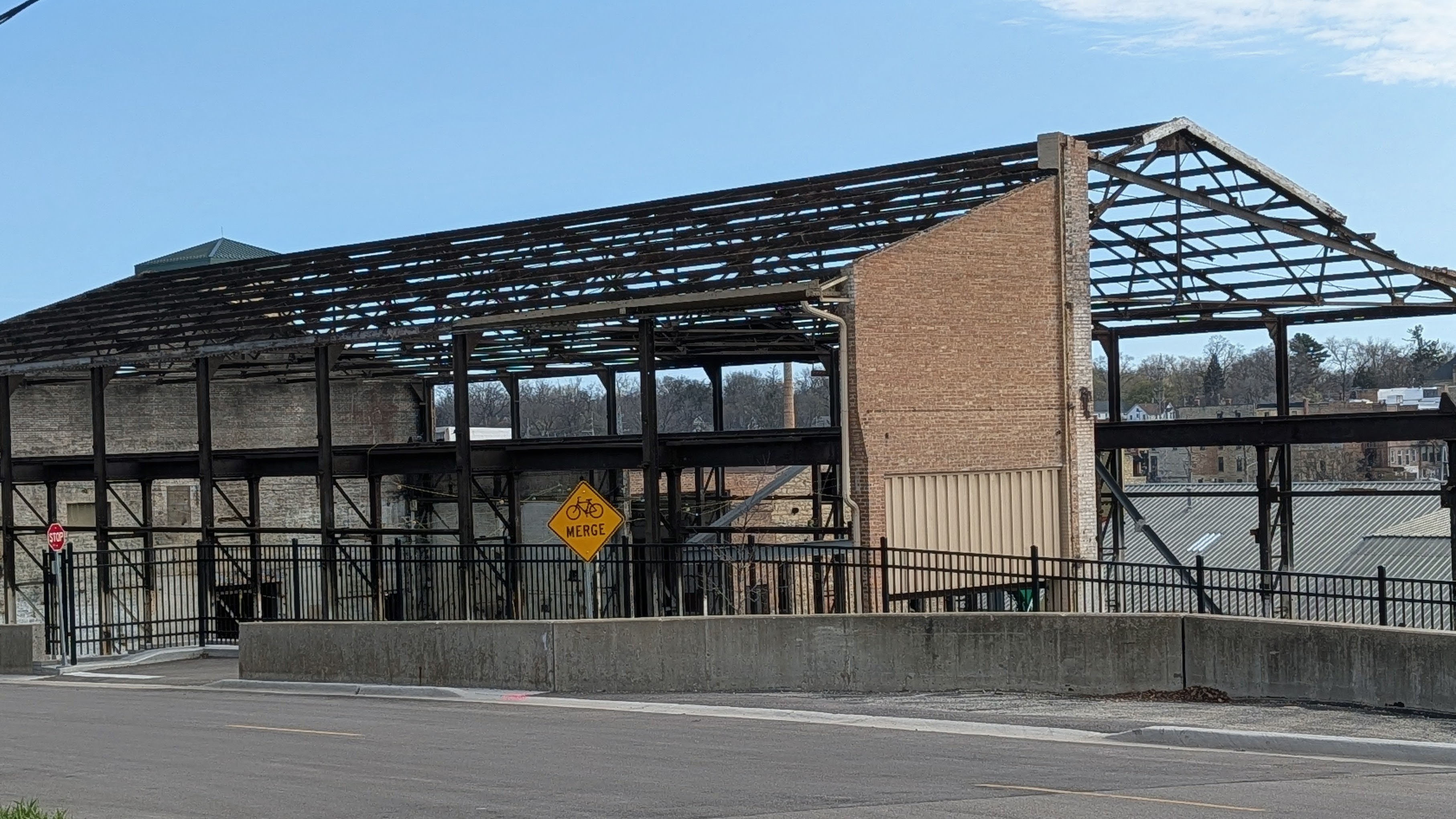
A piece of Batavia’s industrial past is officially stepping into the future. Work has commenced on a major $12 million adaptive reuse project at 190 S. Water Street, transforming a century-old factory into the new global headquarters for QT9 Software.
Currently based in nearby Aurora, the fast-growing technology company—known for its Quality Management, ERP, and MRP software solutions—will relocate its operations to downtown Batavia, bringing jobs and renewed vibrancy to the riverfront.
A Stark Starting Point: The Building’s Prior Condition
As seen in the recent site photo, the starting point for this ambitious redevelopment is a stark reminder of the building’s age and vacancy. Prior to the redevelopment, the structure—the former Pamarco factory—sat in a highly dilapidated state.
Stripped down to its bare industrial bones, the building resembles a skeletal framework more than a functional workspace. The image shows an exposed, rusting steel roof truss system completely devoid of roofing material, leaving the interior open to the elements.
Weathered brick walls remain partially intact on the sides, but the structure lacks windows, insulation, or any modern utility. Once part of the historic U.S. Wind Engine and Pump Co. complex, the 100-year-old site had become an eyesore that required extensive structural, electrical, and plumbing overhauls, as well as partial demolition, just to make the site viable for modern use.
The Vision: Adaptive Reuse
Rather than tearing the 40,000-square-foot structure down completely, developers Manhattan Real Estate Ventures, LLC and the City of Batavia are championing an adaptive reuse strategy. The goal is to preserve the city’s historical character by integrating the surviving industrial architecture into a sleek, modern office environment.
According to Batavia Mayor Jeff Schielke, the project represents a “dynamic change” that will soon see a much nicer-appearing building rise from the currently barren site.
Economic Impact and City Support
This redevelopment is a significant cornerstone in a broader wave of economic growth currently sweeping through the city.
To make the $12 million renovation financially feasible, the Batavia City Council authorized a Redevelopment Agreement that includes approximately $1.87 million in Tax Increment Financing (TIF) incentives. The investment is expected to pay major dividends for the local economy. The project will initially secure QT9’s current workforce of 65 employees, with projections to grow to around 100 staff members.
Furthermore, the redevelopment is expected to add $7 million in Equalized Assessed Value (EAV) to the property, generating over $5 million in incremental tax revenue for the city and other taxing bodies over the life of the new TIF district.
A Broader Resurgence
The QT9 project is part of a highly successful year for the city’s economic development. The tech company’s arrival complements several other major local initiatives, including a new $500 million Hut 8 data center, the transformation of the former Tin Shop into the River Street Plaza, and the introduction of new workforce housing.
By rescuing a dilapidated, roofless shell of a factory and turning it into a thriving hub for software innovation, Batavia is successfully marrying its rich industrial heritage with a lucrative, tech-driven future. Construction on the new QT9 headquarters is expected to be completed by the end of 2028.
Author: Jim Fahrenbach
Leave a Reply