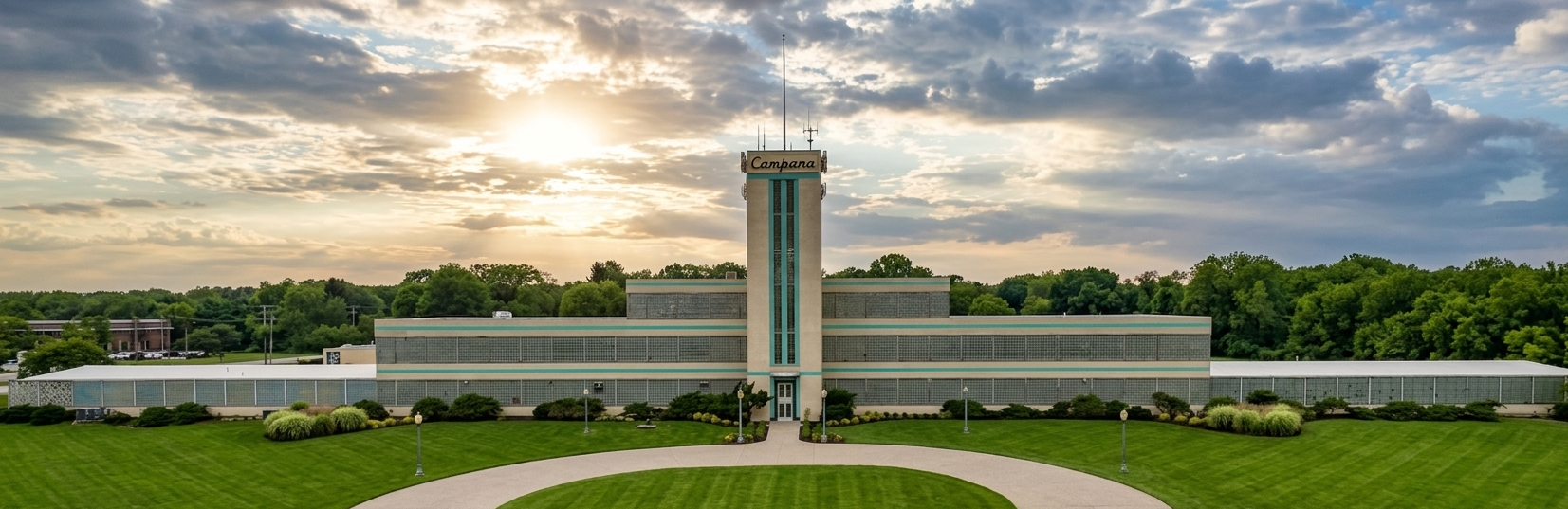
If you drive up Route 31 near Fabyan Parkway, you can’t miss it. The classic exterior, with its horizontal lines, bands of glass block, and turquoise terracotta tile trim, is a definitive piece of Batavia’s architectural identity. As a masterpiece of 1930s industrial design, the Campana Factory is Batavia’s sole property on the national register of historic places, a status it earned through both its prestigious appearance and its ingenious engineering.
Built during the depths of the Great Depression, the facility was the headquarters for The Campana Company, makers of Italian Balm—the best-selling hand lotion in the United States at the time. Company president Ernest Oswalt wanted a building that reflected the modern appeal of his products, and the resulting structure was decades ahead of its time.
| Completed | 1937 |
| Architects | Frank D. Chase; Childs & Smith |
| Style | Streamline Moderne, Art Deco, and Bauhaus |
| NRHP Status | Added to the National Register of Historic Places in 1979 |
A Marvel of Depression-Era Engineering
The building’s core is rugged and virtually indestructible. It was constructed using “cast-in-place” concrete—the same heavy-duty engineering technique used to build bomb shelters. Because it cures as one continuous mass, it has no seams or joints, making it highly durable. Inside, the factory floor boasts soaring 18-foot ceilings, giving the production areas an immense sense of scale.

Despite being built as a facility handling sensitive cosmetic ingredients, the factory’s manufacturing floor is famously windowless. Instead, the architects utilized special glazing and bands of glass brick. This wasn’t just a stylistic choice; it was highly functional, allowing natural light to flood deep into the building and providing expansive internal illumination entirely without electricity.
Because of the sealed nature of the glass block walls, it was also one of the earliest fully air-conditioned factories in the region. The iconic central tower isn’t just decorative—it originally housed a massive 45,000-gallon water tank that fed both the early air-conditioning system and the fire sprinklers. While the water tank is long gone, the 100-foot tower has found a modern purpose hosting cellular antennas.
Gravity-fed production lines dropped cosmetic ingredients from the third floor down to the mechanical mixers on the second. It was an engineering marvel that kept operations running smoothly until the company was eventually sold and manufacturing moved out of state in the early 1980s.
The building still has areas that can be leveraged for light manufacturing or more industrial purposes.

The original sealed, bright environment initially created for cosmetics production also facilitated excellent adaptive reuse. This image highlights how a section of the former factory was transformed into office space. The high, open ceiling and the soft, diffused light flooding through the special glass block walls created bright, high-quality workspaces that felt surprisingly modern.

A Century of Transitions
Peak Production
1936–1937
The state-of-the-art factory is constructed to handle the massive national demand for Italian Balm, fueled by national radio advertising.
Corporate Shifts & Closure
1960s–1982
The Campana Company is purchased by Dow Chemical, then called Purex. Manufacturing operations eventually relocate out of state, and the factory ceases operations in 1982.
County Government Use
1980s–1994
Following the closure of the factory, Kane County experienced rapid growth in the 1980s. To accommodate this expansion, the county began renting space in the former Campana building for the offices of the Circuit Clerk. The Circuit Clerk continued to operate out of the landmark building until at least 1994, when a county master plan aimed to consolidate the courts onto the new Judicial Center Campus in Geneva.
Mixed Commercial Transition & Vacancy
1990s–2010s
After the county offices relocated, the vast industrial footprint transitioned to a mixed-use commercial space, but much of the large concrete manufacturing spaces remained difficult to fill. By the 2010s, the historic building was mostly vacant and in need of significant rehabilitation.
The Evergreen Proposal
2017
A high-profile $30 million proposal to redevelop the historic structure into an 80-unit apartment complex ultimately stalls out due to complex zoning challenges, a parking deficit, and inter-municipal traffic concerns at the Route 31 and Fabyan intersection.
The Campana Building Today
The same features that make the Campana building a historic treasure—the all-steel frame, the “cast-in-place” concrete, the glass block approach, and the massive internal spaces— can make it seem dated compared to more modern buildings.
However, life has returned to the factory floor. In April 2022, the property was purchased by a new owner, Batavia Business Center LLC. Today, the expansive floors have been adapted to host a surprisingly diverse array of businesses, with a distinct and prominent sports focus anchored by Club Fusion Volleyball (https://clubfusionvb.org/)
The raw, cavernous upper levels shown (which perfectly demonstrates the rugged beauty of the original “cast-in-place” concrete construction) are uniquely suited for businesses requiring immense volume.
As the city works to support the expanded use of this facility the Campana building will continue to stand as a beautiful sentinel and a monument to our industrial and civic past.
https://www.loopnet.com/Listing/901-N-Batavia-Ave-Batavia-IL/32160132
Author: Jim Fahrenbach
Leave a Reply