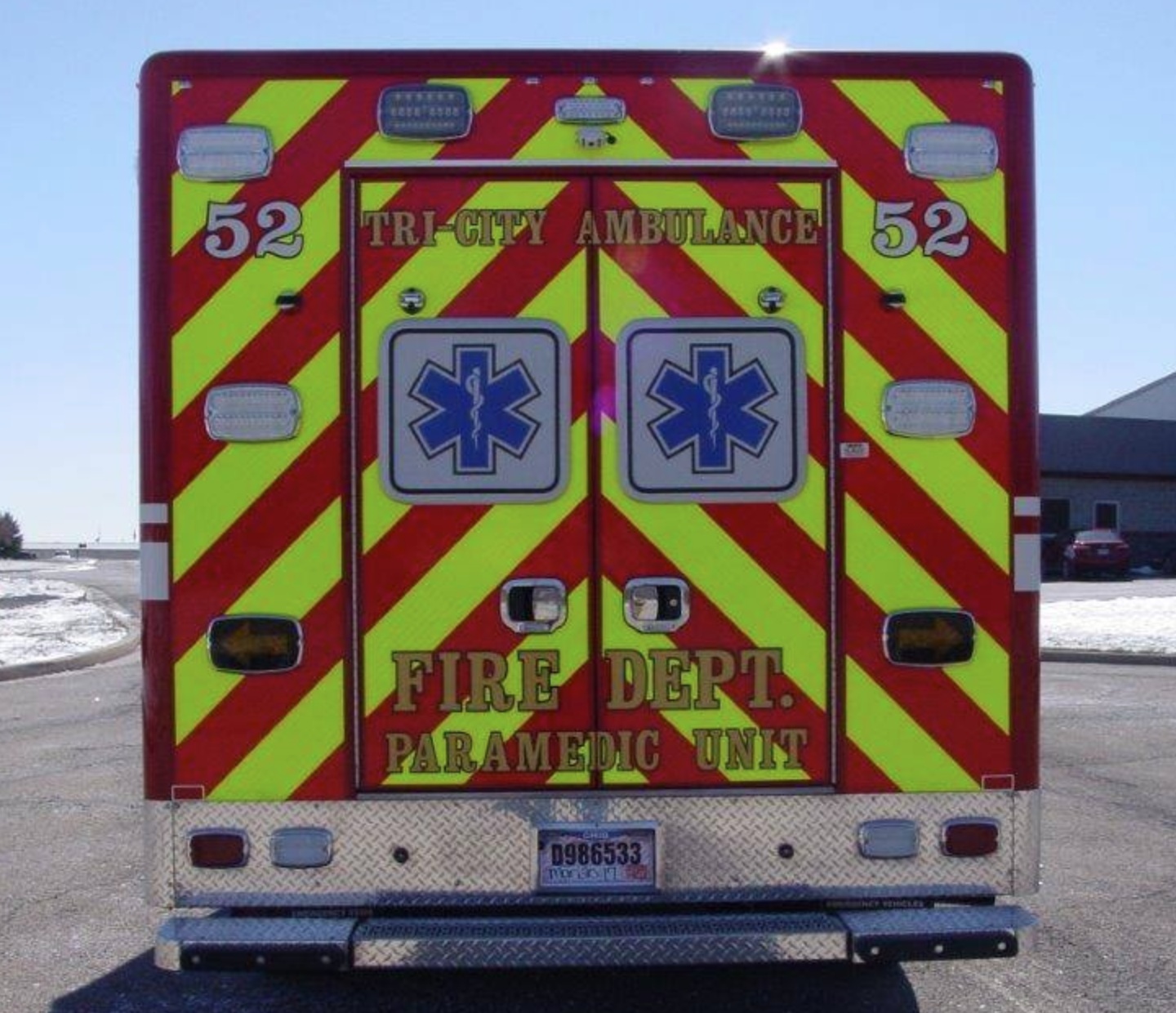
At the April 28, 2026 Committee of the Whole meeting city council tackled several big issues, starting with a lengthy debate over paramedic contracts, before moving on to vehicle software, a new task force charter, and concerns about state zoning legislation.
Tri-City Ambulance (TCA) Service & Paramedic Contracting
The most heated and lengthy debate of the evening centered on the city’s 40-year intergovernmental agreement for the Tri-City Ambulance (TCA) service and its reliance on a private contractor for paramedics. While the shared-city model was broadly supported, heavy scrutiny was placed on the private staffing model, with arguments flaring over transparency, cost-effectiveness, and quality of care. Staff defended the current model as an industry standard shaped by recent post-pandemic labor shortages, while certain elected officials demanded a hard look at the financial feasibility of bringing the services in-house.
- The TCA was formed in the 1980s as an intergovernmental agreement to consolidate and provide ambulance services.
- Paramedics staffing the ambulances are not city employees, but rather contracted workers provided through a private vendor.
- A council member explained that this arrangement is known as a “flexible staffing model,” which provides workers with mobility and the city with predictable costing over the life of a contract.
- Under this model, it is standard for contracted employees to wear city uniforms, a practice referred to in the industry as utilizing “dual badged” employees.
- A council member highlighted severe turnover rates, noting that at least 77 contracted paramedics had been assigned to the city since January 2020, raising concerns about the consistency and quality of local emergency care.
- The cost of the paramedic contract jumped 88% over approximately five years, rising from $2.6 million for 30 paramedics to $4.9 million for 32 paramedics (equating to roughly $154,000 per paramedic annually).
- The Fire Chief and other officials explained that the massive cost increases and turnover were driven by a severe, industry-wide shortage of healthcare workers during and after the COVID-19 pandemic.
- To attract talent, the private contractor recently raised starting salaries to $80,000 and offered $10,000 signing bonuses.
- Despite the contract’s rising cost, city staff maintained that it is still more affordable than hiring municipal firefighters/paramedics due to the immense overhead, pension liabilities, and administrative costs the city would incur.
- Multiple council members expressed frustration over a lack of transparency, requesting that a completed strategic data analysis comparing the costs of in-house paramedics versus the contractor model be shared with the council.
Vehicle GPS & Dashboard Camera Software (Samsara)
The council reviewed the expansion of a vehicle tracking and dashcam software system across various city departments. Following a successful pilot in the streets division, the city is moving to install the technology in dozens of additional municipal vehicles to track locations, monitor vehicle health, and improve emergency response times.
- The software tracks vehicle routes, speed, idle times, and engine codes, and is capable of sending immediate email alerts to city mechanics if a truck pulls a maintenance code.
- The system includes camera footage that can be used to verify resident complaints, such as claims about missed leaf pickups or damaged mailboxes.
- The city capitalized on a 25% discount, committing to a $26,000 total cost this year for shipping and licensing to roll the hardware out to approximately 40 additional vehicles across public works, electric, water, and community development.
- While a memo noted potential employee hesitation regarding “Big Brother” monitoring, staff clarified that the cameras are primarily used for post-incident review, accountability, and emergency deployment, not active all-day surveillance.
Integrated Resource Plan (IRP) Task Force Charter
The council engaged in a detailed word-smithing session to finalize the charter for the newly formed IRP Task Force. The discussion centered on ensuring the task force’s guiding document correctly mirrored the city’s established energy policies and had clear logistical boundaries.
- After a debate over the exact terminology used in the city’s energy policy, the council agreed that the task force’s four guiding objectives are: reliability, sustainability, affordability, and adaptability.
- Contradictory member counts in the draft charter were corrected to explicitly state the task force will consist of seven voting members and one city council liaison.
- The council agreed to add a termination date to the charter so the task force ends, with the option for the council to vote to extend it if necessary.
- The city is required by state statute to deliver a concise report of its analysis and findings regarding the energy plan by January 1, 2028.
BUILD Illinois Legislation & Local Zoning Control
The council held a deeply concerned, extensive discussion regarding the proposed state “BUILD Act” legislation, which threatens to strip municipalities of their local zoning authority. Officials warned that the state’s attempt to mandate high-density residential housing without local oversight could result in severe infrastructure crises and immense backlash from current residents. The council agreed to closely monitor the bill and consider formal opposition.
- The Illinois Municipal League has circulated a model resolution asking local communities to formally oppose the BUILD Act due to its removal of local residential zoning control.
- The Mayor reported that regional leaders are highly alarmed, as individuals are already scouting local neighborhoods to identify homes with large backyards or side yards that could be quickly subdivided for additional housing units if the bill passes.
- Scouts have reportedly been requesting access to municipal water and sewer maps to verify if the underground infrastructure can support the addition of these sudden, high-density retrofits.
- A council member pointed out the physical impossibility of this in many landlocked areas, noting that existing sewer systems only have a finite capacity and cannot handle unchecked residential expansion.
- The Mayor warned that residents will be “screaming and howling” at the city if the state suddenly allows developers to cram new, smaller houses into existing neighbors’ backyards.
- Council members criticized the state legislature for operating in a vacuum, noting the lack of town halls or communication efforts to sell or explain such a massive foundational change to local communities.
- The city plans to prioritize the topic in future meetings to ensure they are prepared to push back against state overreach and protect their constituents.
Honorary Street Signs Policy
A brief discussion was held regarding a request to install an honorary street sign for a recently deceased community member. Recognizing the precedent this would set, the council agreed that a formal policy is needed before approving such requests.
- The City Administrator reported receiving a novel request to install a brown “in memoriam” street sign under a standard green street sign.
- A council member expressed concern that a proliferation of honorary signs could become a dangerous visual distraction for drivers at already congested intersections.
- The council suggested that alternative memorials—such as dedicating a park, planting a tree, installing a bench, or establishing a scholarship—might be more meaningful and safer ways to honor residents.
General City Updates & Announcements
The meeting wrapped up with a series of positive departmental updates. City staff highlighted recent grant awards, community engagement events, and took time to recognize internal employees for their hard work.
- City leadership will meet with the new Executive Director of the Kane County Economic Development Corporation to strategize on recruiting small-scale manufacturing businesses to the downtown area.
- In celebration of Arbor Day, the streets division delivered 475 trees to fourth graders, and the environmental commission gave away 600 tree saplings in front of City Hall.
- The Park District secured a $200,000 grant for a creek tributary project, which directly cuts the city’s 50/50 cost-share burden by $100,000.
- The electric division successfully energized equipment upgrades at the main substation.
- The city formally recognized its administrative professionals, praising them as the “backbone of the organization” for their exceptional customer service and for handling resident complaints gracefully, such as those regarding the recent refuse contract.
Author: Jim Fahrenbach
Leave a Reply