TL;DR
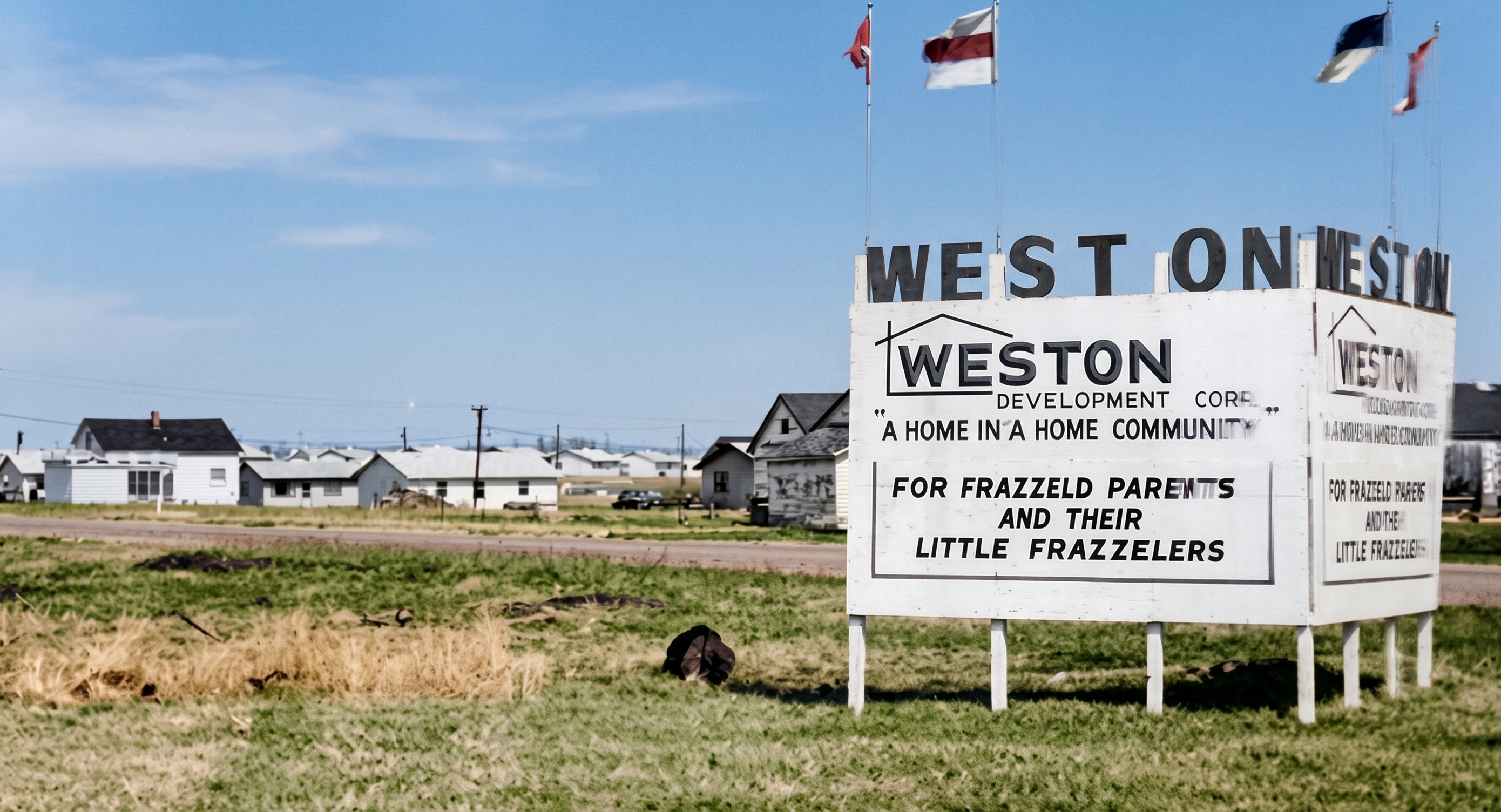
Weston, Illinois, a former farming community of about 100 homes, was voted out of existence in 1966 to provide the site for Fermilab. Before the government buyout, a developer had envisioned transforming Weston into a futuristic city of 50,000 residents featuring “swinging singles” communities. Instead of destroying the original homes, Fermilab preserved them as an academic village. Today, Fermilab has partnered with the Oak Ridge National Laboratory and the Midwest Energy Efficiency Alliance to retrofit these historic structures into a “living lab” testing green housing solutions for the Midwest.
There’s an odd renewal going on regarding Batavia’s long lost sibling, Weston, Illinois, which was the town that was “put to rest” to make way for Fermilab. As Weston was founded with a lot of the same DNA as Batavia, there’s an “alternative universe” where the “tri-cities” are actually called the “quad-cities”.
On the other hand, maybe it’s still called the “tri-cites” because North Batavia didn’t succeed and create the rebel nation of Geneva.
Weston was originally a farming community of about 100 homes, and voted out of existence by its own village board in 1966 to provide a site for the Fermilab National Accelerator Laboratory.
We have families in Batavia who can trace their ancestral farms to the land now occupied by the Fermi campus, and they remember the government buyout well. By 1968, the State of Illinois had purchased 6,800 acres, encompassing Weston and the surrounding farmland, to hand over to the U.S. Atomic Energy Commission.
Before the government stepped in, there were big plans for Weston after the nearby highways were built and basically created the opportunity to create entirely new cities from nothing.
A developer named William Riley envisioned transforming the area into a futuristic city of 50,000 residents and 11,000 homes. Riley aggressively marketed the project, taking out ads promoting “the wondrous city of Weston,” which was slated to feature the world’s largest shopping mall, man-made lakes, and an airport.
Oddly enough, Riley was known for building what he called “swingle”, or “swinging singles”, communities, which would have added a “kink” to the planned development and was hilarious in retrospect.
The layout of the proposed city is shown below, and with it’s wide bolevards and massive buildings does seem to be a bit “1940’s Central European” in it’s approach. The shopping mall is the complex at the center of it.

Text accompaining the image is as follows: “The new city of Weston, Illinois, plans for which were announced today (January 7, 1964) will appear like this from a plane or helicopter making an approach to the airport (lower right). In the center is the Rainbow Shopping Circle, designed for uninterrupted traffic flow, without stop signs, on two ten-lane business streets. An industrial park, medical complex, 73 miles of bridle paths, and a wide variety of recreational facilities have been pre-planned for Weston, which will have a population of 50,000 within 18 months. Riley Management Corporation, Bellwood, Ill., is the primary developer of the community 27 miles west of Chicago.”
Fortunately for our local landscape, the developer lacked the financing, and his vision collapsed within months. The DuPage County State’s Attorney stepped in and sued, claiming that Weston wasn’t properly incorporated and legally lacked the power to annex the land required for the massive project. With the mega-development bankrupt and blocked, the land was primed for the Fermilab we know today.
Rather than bulldozing Weston’s remnants, some of the original properties and outbuildings were preserved as part of Fermilab’s academic village. To stretch early construction budgets, these historic farmhouses and residential structures were physically moved around the site and converted into administrative offices and housing for visiting physicists. Weston, although no longer a city, did physically live on.
Recently, these aging Weston buildings have taken on a brand-new scientific mission. Fermilab has partnered with Oak Ridge National Laboratory (ORNL) and the Midwest Energy Efficiency Alliance (MEEA) to turn the Village into a “living lab” for energy retrofits. Researchers are currently installing sensors to track temperature, humidity, and HVAC performance in the old homes. This real-world data will guide phased, high-tech energy efficiency upgrades, testing innovative green building solutions in Weston’s original footprint that could eventually be deployed across the entire Midwest.
There’s no other place on the planet where buildings from a bygone city are being updated and leveraged to create a new blueprint for green housing.
| Links | |
|---|---|
| Sources |
|
Author: Jim Fahrenbach



Leave a Reply