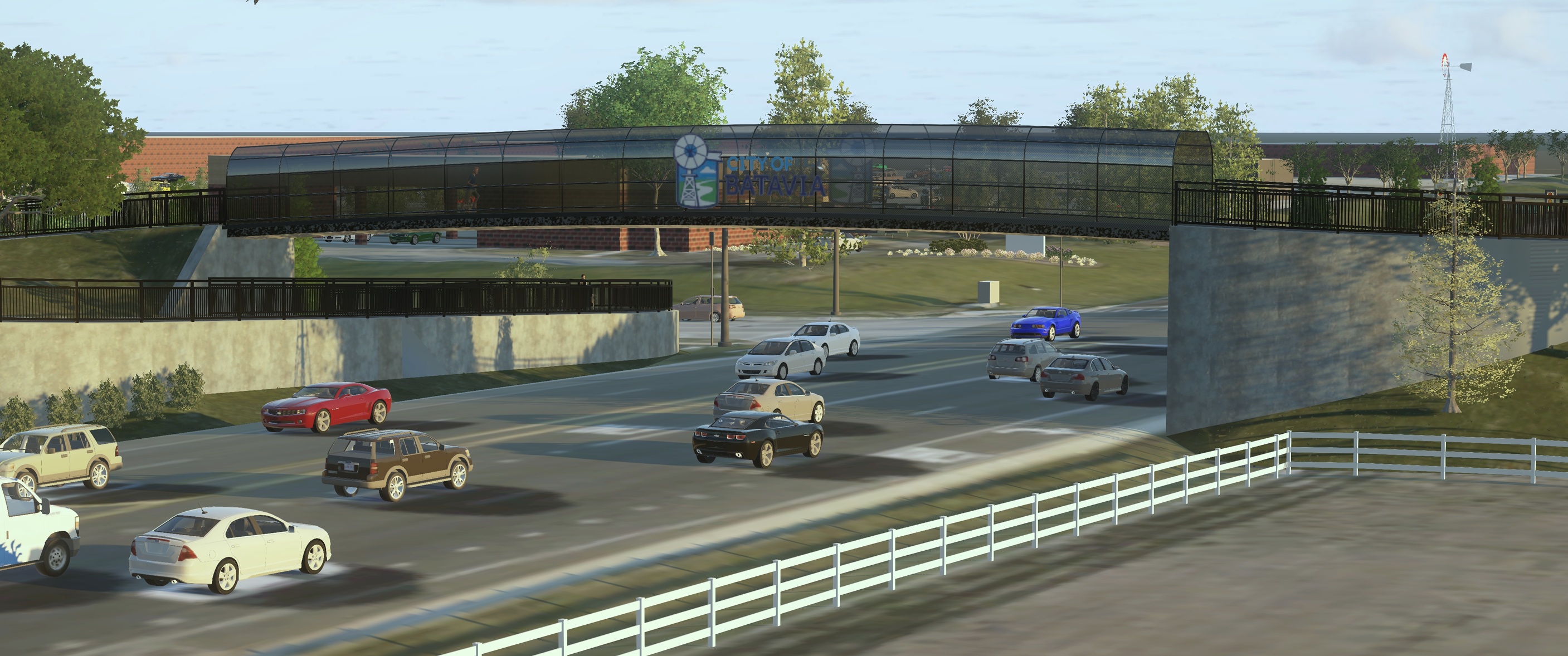
Batavia city officials are evaluating a feasibility study for a new grade-separated pedestrian and bicycle crossing at the intersection of Randall Road and Main Street. During a recent Committee of the Whole meeting, the City Council reviewed potential designs aimed at addressing safety concerns in an area described by residents as a “no-go zone” for pedestrians.
The Proposed Options
A feasibility study conducted by a consulting engineering firm evaluated eleven potential alignments for the crossing. The study ultimately recommended three “preferred” alternatives, all located south of Main Street due to favorable topography and fewer real estate impacts.
The three preferred options presented were:
- Alternative 3: A bridge over Randall Road south of Main Street with loop ramps on both sides, estimated to cost between $3.1 million and $4.3 million.
- Alternative 4: A bridge over Randall Road south of Main Street featuring a loop ramp on the west side and a parallel ramp on the east, also estimated between $3.1 million and $4.3 million.
- Alternative 9: An underpass (culvert) running beneath Randall Road south of Main Street with parallel ramps. This was the most adaptable and cost-effective option, estimated at $2 million to $2.4 million, though it would require significant traffic disruption during construction
Consultants noted that the south side was chosen because the road profile slopes downward there, making it easier to construct ramps without fighting the grade. Additionally, options on the north side faced challenges regarding right-of-way, utility conflicts, and the need for large retaining walls.
The “North vs. South” Debate
Despite the engineering logic for a southern crossing, council members and residents pushed back, arguing that the actual “desire lines”—where pedestrians want to go—are north of Main Street.
Alderperson Fahrenbach noted that teenagers frequently cross Randall Road to reach businesses like Target and Jewel, which are located north of the intersection. Several alderpersons argued that building a crossing south of Main Street would create “perceived indirection,” forcing pedestrians to walk away from their destination to cross, which might discourage use.
“If they’re not going to go south, they’re not going to go north,” one council member remarked, emphasizing that users would likely ignore a crossing that isn’t convenient.
Several council members requested that a specific northern alternative, “Option 6,” be retained for further consideration to allow for a direct comparison, even if it is more expensive. The cost for this northern alternative was estimated between $3.4 million and $4.7 million.
Challenges and Funding Feasibility
The project faces significant hurdles regarding timing and funding. A senior civil engineer noted that Kane County has a long-range plan (looking toward 2050) to widen Randall Road to six lanes. This creates a risk that any bridge or tunnel built now could conflict with future road expansion.
Furthermore, the reconstruction of Main Street has been delayed and broken into phases due to funding caps, meaning sidewalk connections to the potential crossing might not be built immediately.
Regarding financial viability, the mayor warned that the current political climate and high competition make near-term funding unlikely. He noted that there are queries for at least 20 similar crossings along the Randall Road corridor in the region, creating “huge competition” for grants. The mayor also cited political friction between the state and federal administrations as a potential barrier to securing necessary funds.
Consequently, the project is viewed as a long-term vision—potentially 10 to 20 years out—rather than an immediate construction project.
Next Steps
Currently, there is no money budgeted for the next phase of engineering (Phase 1), which is required to apply for major state and federal grants.
To address the Council’s feedback, city staff agreed to meet with the Kane County Division of Transportation (KDOT) to discuss the feasibility of the northern options again. Staff intends to report their findings back to the Council in the coming months, potentially in March, to determine if the city should budget for Phase 1 engineering in future years.
Feasibility Study Link: https://bataviail.community.highbond.com/document/9e94c4ab-d39f-46e2-a3e1-38d65d4f7e48
Author: Jim Fahrenbach
Leave a Reply